
Sermon 16th August 2026
(12h SUNDAY after PENTECOST)
“Thus says the Lord God, who gathers the outcasts of Israel,
I will gather others to them besides those already gathered.” Isaiah 56:8
If I were to burst into song:
The Mississippi Delta
Was shining like a National guitar
I am following the river
Down the highway
Through the cradle of the Civil War
Would you recognise/could you join in the chorus?
I’m going to Graceland, Graceland
Memphis, Tennessee, I’m going to Graceland
Poor boys and pilgrims with families
And we are going to Graceland
It is forty years this month since Paul Simon, he of Simon & Garfunkel,
released his Graceland album.
Last night the Proms hosted an anniversary celebration
of the 1986 Grammy award winning, Best Album of the Year.
Simon had found inspiration after hearing a bootleg cassette
of South African township music,
prompting him to travel to Johannesburg to record with local musicians.
A huge commercial success, but controversial,
because Simon’s going to then-apartheid South Africa –
flaunted a UN-backed cultural ban, in place at the time.
The title track, Graceland meditates on a pilgrimage made with his son
to Elvis Presley’s Graceland home,
at a time when his own marriage had ended
and his most recent album had been poorly received.
Poor boys and pilgrims with families
And we are going to Graceland
My traveling companion is nine years old
He is the child of my first marriage
But I’ve reason to believe
We both will be received
In Graceland.
Reason to believe we will all be received, in Graceland?
Do you sense that when you enter this building/this sanctuary,
(or watch online/listen via telephone dial in)
or any of the places of worship familiar to you?
Do we find, do we embody, a genuine “graceland”?
Is our house of prayer, our congregation, a house for all peoples – outcasts and others?
If not, who is missing? And why?
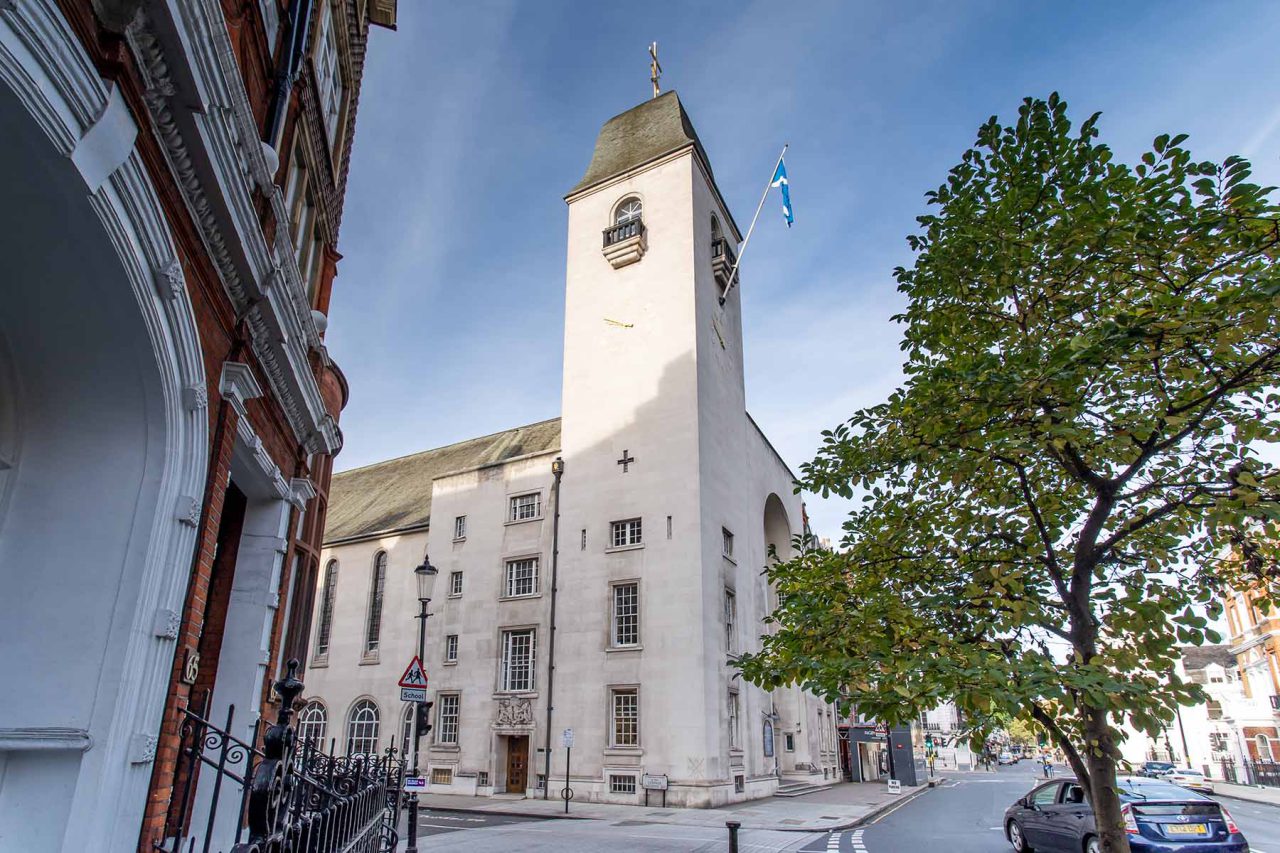
At our front door: “My house shall be called a house of prayer.”
Complete with angel and Saltire.
A borrowing from the fuller scripture read this morning:
My house shall be called a house of prayer for all peoples/all nations.
A reminder? A rebuke?
A vision statement? A dare?
A promise? A risk?
Third Isaiah – the quotation’s source,
addresses the recent exiles returned from Babylon
to a newly repopulated Jerusalem and its temple.
The Lectionary edits, but if you read the fuller passage, Isaiah 56:1-8,
the author singles out two constituencies that must be addressed by the chosen ones:
eunuchs and foreigners.
The old laws were pretty categoric on the former –
no entry into the temple, on account of their disfigurement or disabling.
Ethnicity too is not to prove a barrier.
Prioritise doing the right thing – justice;
maintain the covenant relationship with God,
observe the sabbath, come with good intent, humility and reverence;
these are the conditions of entry.
To the “untouchables”(eunuchs), the promise:
“I will give, in my house and within my walls,
a monument and a name better than sons and daughters;
I will give them an everlasting name that shall not be cut off.”
And the foreigners who join themselves to the Lord, hold fast the covenant—
“…these I will make joyful in my house of prayer;
for my house shall be called a house of prayer for all peoples.” Isaiah 56: various
The universality of God’s love and compassion,
drawn to and expressed in, a house of prayer:
It’s a beautiful ideal – in the abstract –
the reality is not so straightforward.
“I love humanity, it’s just people I find difficult.”
Easier to hoard the Good News among friends
than share with awkward strangers?
Perhaps the Gospel story – disturbing as it is – offers encouragement.
Jesus has been sparring with the religious authorities.
Quoting the prophet Isaiah 29:13, he concludes:
“This people honours me with their lips, but their hearts are far from me.” Matthew 15:9
Wearied perhaps by these bruising encounters, Jesus seeks peace elsewhere;
heads to Tyre and Sidon; modern day Lebanon.
Historically – a centre of Baal worship – Border/Bad-lands.
His disapprovers would spit: Gone to the dogs: Jewish insult for the gentile.
He encounters the anonymous Canaanite; a hostile tribe –
strange gods, ritually unclean. And a woman.
Foreign and female – definitely off-limits for any self-respecting rabbi.
But hers is the heart cry: God save the child.
“Have mercy on me; my daughter is tormented by a demon.”
Within the plea, an acknowledgement; Lord, Son of David.
Here beyond the boundaries of Israel, on the lips of the ill-informed – the Messiah’s title.
At first, no answer.
Was Jesus indifferent, fed up, compassion fatigued;
was he leaving space to see how his disciples would react?
Or was he stunned by her address –
hearing an understanding, lacking among the folks
who spoke his dialect, knew his kin, and shared his God.
The woman persists. The handlers step in.
“Send her packing Master. She’s not our business. We’re not hers.”
Jesus’ inward thoughts:
“I was sent only to the lost sheep of Israel.”
God knows, task enough. So, this one – is beyond the fold.
But as the disciples attempt to shush her,
she comes and kneels before Jesus.
Perhaps he hears, now recognises, an uncomfortable echo –
of the recent impasse with the Pharisees and their argued exclusions?
“You are not the one for who I was sent.
It is not fair to take the children’s food and throw it to the dogs.”
To which, the famous repost:
“Says who? Even the dogs eat the crumbs that fall from their masters’ table.
Jesus, I beg you: Just a broken edge of your dream,
that my child’s nightmare might end.”
Checkmate: the blessing is wrestled forth from Jesus.
“Woman great is your faith!” The girl is made well.
That is the miracle/message, from beyond the border:
arguably, it is Jesus who is healed.
The woman’s feisty heckle provokes a revelation.
Jesus does that most difficult thing for those born,
into a particular privilege or dominance;
he listens, then allows himself to be changed.
“Surely there’s enough for me and my daughter”, says the stranger.
And perhaps to his own surprise Jesus says, “Yes. Yes, there is.”
Causing us to reflect?
On where and when, by who and how,
we have felt included, or in contrast, excluded?
Causing us to reflect,
where the widening of our inclusions might lead us –
individually, or as congregation, as neighbourhoods or nation?
Jesus is big enough, humble enough,
to listen and learn from the desperate Canaanite mother –
she, a milestone on the highway of ever-expanding vison.
God’s purposes for him are grander than hitherto imagined.
Via her raw humanity, her schooling,
he is stretched to a wider circle of compassion,
a deeper comprehension of God’s love.
The divine inclusion rectifies/purifies, man-made exclusions.
“Thus says the Lord God, who gathers the outcasts of Israel,
I will gather others too, besides those already gathered.”
Reason to believe, we all might be received
(and receiving)
in Graceland.
Sermon 30th August, 2026
(FOURTEENTH SUNDAY AFTER PENTECOST)
Then Moses said, “I must turn aside and look at this great sight,
and see why the bush is not burned up.” Exodus 3:
The poet Thomas Stafford referred to it as the “sacred practice of noticing.”
Poets, painters, toddlers – are surely the master practioners.
The giving of attention, the permitting of curiosity to really examine
the something so many of us simply pass by.
Among artist David Hockney’s last works:
“Put your phone down; look with both eyes.”
In a poem by the late Anglican priest, David Scott,
he gives close attention to a quite ordinary moment –
the sight of an anonymous nun/a religious sister, at a train station –
A Nun on the Platform
She seems in place here,
as much as in the convent,
self-contained, neat.
You could hardly call it luggage.
No frantic balancing of cups
but like a swan,
which also has no hands for magazines,
she stands complete.
Scott contrasts the nun’s unhurriedness with that of the fellow passengers,
Reflecting: “We are all some distance from our roots on this platform,
but she seems at home.”
Then concludes:
Seeing a nun on a platform
gives the day a jolt,
like an act of kindness,
or a pain that halts.
Look with both eyes – the giving of attention – a jolt to the day –
is the catalyst for all that follows in this morning’s famous Exodus tale –
the bush that burns, but is not burnt out.
There is of course quite a back story, before we reach this holy ground,
out beyond the wilderness, at the mountain of God.
Moses, Hebrew child in Egypt;
born into a time when the former glories of Joseph and the privileges enjoyed are long gone – a new era, a new Pharoah, who knew nothing of things past.
Instead, a reign of terror – a genocide – or more specifically, an infanticide.
An order of atrocity – to kill the male children of the Hebrews.
Moses saved by the actions of women, both Hebrew and Egyptian –
midwives who resisted the high command;
mother and sister of the child who placed the reed basket on the Nile,
princess of Egypt, who came to bathe, but ended up preserving the child’s life.
So, through the twists and turns of circumstance,
the slender thread is preserved.
Moses is raised a prince of Egypt, in a time of oppression
for the people from whom he hails, but hardly knows.
Then, grown to adulthood, in a moment of fury,
killing an overseer who he sees mistreating a Hebrew slave.
Forced to flee.
Now an exile, beyond the wilderness, on the slopes of Mount Horeb,
tending the flocks of his father-in-law, the priest of Midian.
There, his day receives the jolt that will change his life forever;
turning aside, drawn in curiosity, looking with both eyes;
the bush that blazed, yet was not consumed,
the flame that speaks;
“Come no closer! Remove the sandals from your feet,
for the place on which you are standing is holy ground.”
Shoes off. In the presence of the living God,
reverence and awe, the correct and only response.
Reverence and awe are the avenue to the message waiting to be delivered.
A familiar biblical exchange – a name called, a response given:
“Moses, Moses!”- “Here I am.”
“I am the God of your father, the God of Abraham, the God of Isaac, and the God of Jacob.”
You are connected to the generations gone before;
Now you are commissioned – to liberate your brothers and sisters, from the slavery of Egypt – an oppression, which until very recently, you have been a part of.
“Who am I that I should go to Pharaoh, and bring the Israelites out of Egypt?”
A not unreasonable question.
The Divine answer: “I will be with you.”
“Very well. But what if I come to the Israelites and say to them,
“The God of your ancestors has sent me to you”,
If they reply: Really, what is his name?
I know the name of many gods in Egypt – what shall I say?
Tell them my name is: ‘I am who I am.’
Tell them: “I am has sent me to you.”’
This is my name for ever,
and this my title for all generations.
There is little indication that Moses understood what God’s name meant –
it was then, it remains now shrouded in mystery –
reminder that God will not be pinned down, like a butterfly,
to a single name, image, or even a single understanding.
Some suggest that I am who I am should be considered a verb, not a noun.
So, conveying movement and intangibility,
Rather than a fixed noun, that will gather dust in a museum cabinet.
However much, or little, Moses comprehended,
the encounter sets him on a new and unforseen course,
for himself and for his people of origin.
In the face of the call, Moses goes –
and the great story of liberation unfolds.
On that journey, there will be moments of failure, rejection, discouragement,
but also, perseverance, prayer, deliverance and above all,
through thick and thin, God’s abiding presence, God’s “I am.”
Where might our attention be drawn today?
Where are the cries of the needy, a summons?
A summer of wildfires and the landslides of the Nepal-Tibet border
are stark reminders of the strain humanity is placing upon a fragile Earth.
Tuesday marks the beginning of a designated Season of Creation;
September 1st, World Day of Prayer for the Care of Creation
to October the 4th – feast day of St Francis of Assisi.
The Season of Creation is an ecumenical initiative
inviting the Churches to be united in prayer and protection for our single island planet home.
This year the theme is “Listen to the Voice of Creation”,
introduced with the observation:
“During the pandemic lockdowns,
many experienced their local environment to be quieter.
People heard bird song for the first time in their street,
noticed the different sounds of wind in the leaves of different trees.
It was as if each tree had a different signature tune to play.”
“Listen to the Voice of Creation” is offered in the hope
that through it, we might glimpse a deeper present and a different future.
Pope Leo reflecting on the coming day of prayer for the care of Creation,
outlines the link between the disharmonies of humankind and those of nature;
the calamities inflicted by the violence of our living
our inability to live peaceably, or within limits.
But concludes on the call to live differently:
“If we take up this task with humility and faith,
we will become collaborators in God’s work of renewal.
We will move, slowly but surely,
from desert to garden,
from division to communion,
and from violence to peace.”